Pages

Friday, 15 June 2018

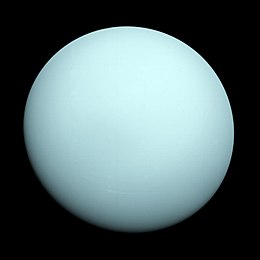
Uranus Uranus

Uranus2.jpg
Uranus is the seventh planet from the Sun. It has the third-largest planetary radius and fourth-largest planetary mass in the Solar System. Uranus is similar in composition to Neptune, and both have different bulk chemical composition from that of the larger gas giants Jupiter and Saturn. For this reason, scientists often classify Uranus and Neptune as "ice giants" to distinguish them from the gas giants. Uranus's atmosphere is similar to Jupiter's and Saturn's in its primary composition of hydrogen and helium, but it contains more "ices" such as water, ammonia, and methane, along with traces of other hydrocarbons.It is the coldest planetary atmosphere in the Solar System, with a minimum temperature of 49 K (−224 °C; −371 °F), and has a complex, layered cloud structure with water thought to make up the lowest clouds and methane the uppermost layer of clouds. The interior of Uranus is mainly composed of ices and rock.

Like the other giant planets, Uranus has a ring system, a magnetosphere, and numerous moons. The Uranian system has a unique configuration among those of the planets because its axis of rotation is tilted sideways, nearly into the plane of its solar orbit. Its north and south poles, therefore, lie where most other planets have their equators. In 1986, images from Voyager 2 showed Uranus as an almost featureless planet in visible light, without the cloud bands or storms associated with the other giant planets. Observations from Earth have shown seasonal change and increased weather activity as Uranus approached its equinox in 2007. Wind speeds can reach 250 metres per second (900 km/h; 560 mph).[18]Uranus is the only planet whose name is derived directly from a figure from Greek mythology, from the Latinised version of the Greek god of the sky Ouranos.

Pluto


Nh-pluto-in-true-color 2x JPEG-edit-frame.jpg

Pluto (minor planet designation: 134340 Pluto) is a dwarf planet in the Kuiper belt, a ring of bodies beyond Neptune. It was the first Kuiper belt object to be discovered.Pluto was discovered by Clyde Tombaugh in 1930 and was originally considered to be the ninth planet from the Sun. After 1992, its status as a planet was questioned following the discovery of several objects of similar size in the Kuiper belt. In 2005, Eris, a dwarf planet in the scattered disc which is 27% more massive than Pluto, was discovered. This led the International Astronomical Union (IAU) to define the term "planet" formally in 2006, during their 26th General Assembly. That definition excluded Pluto and reclassified it as a dwarf planet.Pluto is the largest and second-most-massive known dwarf planet in the Solar System, and the ninth-largest and tenth-most-massive known object directly orbiting the Sun. It is the largest known trans-Neptunian object by volume but is less massive than Eris. Like other Kuiper belt objects, Pluto is primarily made of ice and rock and is relatively small—about one-sixth the mass of the Moon and one-third its volume. It has a moderately eccentric and inclined orbit during which it ranges from 30 to 49 astronomical units or AU (4.4–7.4 billion km) from the Sun. This means that Pluto periodically comes closer to the Sun than Neptune, but a stable orbital resonance with Neptune prevents them from colliding. Light from the Sun takes about 5.5 hours to reach Pluto at its average distance (39.5 AU).Pluto has five known moons: Charon (the largest, with a diameter just over half that of Pluto), Styx, Nix, Kerberos, and Hydra. Pluto and Charon are sometimes considered a binary system because the barycenter of their orbits does not lie within either body.On July 14, 2015, the New Horizons spacecraft became the first spacecraft to fly by Pluto. During its brief flyby, New Horizons made detailed measurements and observations of Pluto and its moons. In September 2016, astronomers announced that the reddish-brown cap of the north pole of Charon is composed of tholins, organic macromolecules that may be ingredients for the emergence of life, and produced from methane, nitrogen and other gases released from the atmosphere of Pluto and transferred about 19,000 km (12,000 mi) to the orbiting moon.

Black holes

Schwarzschild black hole
A black hole is a region of spacetime exhibiting such strong gravitational effects that nothing—not even particles and electromagnetic radiation such as light—can escape from inside it. The theory of general relativity predicts that a sufficiently compact mass can deform spacetime to form a black hole. The boundary of the region from which no escape is possible is called the event horizon. Although the event horizon has an enormous effect on the fate and circumstances of an object crossing it, no locally detectable features appear to be observed. In many ways a black hole acts like an ideal black body, as it reflects no light. Moreover, quantum field theory in curved spacetime predicts that event horizons emit Hawking radiation, with the same spectrum as a black body of a temperature inversely proportional to its mass. This temperature is on the order of billionths of a kelvin for black holes of stellar mass, making it essentially impossible to observe.
Objects whose gravitational fields are too strong for light to escape were first considered in the 18th century by John Michell and Pierre-Simon Laplace. The first modern solution of general relativity that would characterize a black hole was found by Karl Schwarzschild in 1916, although its interpretation as a region of space from which nothing can escape was first published by David Finkelstein in 1958. Black holes were long considered a mathematical curiosity; it was during the 1960s that theoretical work showed they were a generic prediction of general relativity. The discovery of neutron stars in the late 1960s sparked interest in gravitationally collapsed compact objects as a possible astrophysical reality.
Black holes of stellar mass are expected to form when very massive stars collapse at the end of their life cycle. After a black hole has formed, it can continue to grow by absorbing mass from its surroundings. By absorbing other stars and merging with other black holes, supermassive black holes of millions of solar masses may form. There is general consensus that supermassive black holes exist in the centers of most galaxies.
Despite its invisible interior, the presence of a black hole can be inferred through its interaction with other matter and with electromagnetic radiation such as visible light. Matter that falls onto a black hole can form an external accretion disk heated by friction, forming some of the brightest objects in the universe. If there are other stars orbiting a black hole, their orbits can be used to determine the black hole's mass and location. Such observations can be used to exclude possible alternatives such as neutron stars. In this way, astronomers have identified numerous stellar black hole candidates in binary systems, and established that the radio source known as Sagittarius A*, at the core of our own Milky Way galaxy, contains a supermassive black hole of about 4.3 million solar masses.
On 11 February 2016, the LIGO collaboration announced the first detection of gravitational waves, which also represented the first observation of a black hole merger. As of April 2018, six gravitational wave events have been observed that originated from merging black holes

Milky way

Image result for milky way

The Milky Way is the galaxy that contains our Solar System. The descriptive "milky" is derived from the appearance from Earth of the galaxy – a band of light seen in the night sky formed from stars The Milky Way is the galaxy  that contains our Solar System. The descriptive "milky" is derived from the appearance from Earth of the galaxy – a band of light seen in the night sky formed from stars that cannot be individually distinguished by the naked eye. The term Milky Way is a translation of the Latin via lactea, from the Greek γαλαξίας κύκλος (galaxías kýklos, "milky circle"). From Earth, the Milky Way appears as a band because its disk-shaped structure is viewed from within. Galileo Galilei first resolved the band of light into individual stars with his telescope in 1610. Until the early 1920s, most astronomers thought that the Milky Way contained all the stars in the Universe. Following the 1920 Great Debate between the astronomers Harlow Shapley and Heber Curtis, observations by Edwin Hubble showed that the Milky Way is just one of many galaxies.The Milky Way is a barred spiral galaxy with a diameter between 100,000 and 180,000 light-years (ly). It is estimated to contains 100–400 billion stars. There are probably at least 100 billion planets in the Milky Way.  The Solar System is located within the disk, about 26,000 light-years from the Galactic Center, on the inner edge of the Orion Arm, one of the spiral-shaped concentrations of gas and dust. The stars in the innermost 10,000 light-years form a bulge and one or more bars that radiate from the bulge. The galactic center is an intense radio source known as Sagittarius A*, likely a supermassive black hole.Stars and gases at a wide range of distances from the Galactic Center orbit at approximately 220 kilometers per second. The constant rotation speed contradicts the laws of Keplerian dynamics and suggests that much of the mass of the Milky Way does not emit or absorb electromagnetic radiation. This mass has been termed "dark matter". The rotational period is about 240 million years at the position of the Sun.The Milky Way as a whole is moving at a velocity of approximately 600 km per second with respect to extragalactic frames of reference. The oldest stars in the Milky Way are nearly as old as the Universe itself and thus probably formed shortly after the Dark Ages of the Big Bang.
The Milky Way has several satellite galaxies and is part of the Local Group of galaxies, which form part of the Virgo Supercluster, which is itself a component of the Laniakea Supercluster.

Ignite


Image result for ignite

Today we have been learning about the word ignite and some of us knew word meant. I've heard of the word before but I didn't really recognise what it meant. I thought it meant getting ready to fire up or just starting your engine.

Milky way part 2

100,000 light years
It's puny compared to M87, an elliptical galaxy 980,000 light years in diameter. The Milky Way is only100,000 light years in diameter. Let's not even get into Hercules A, which is 1.5 million light years across.Apr 4, 2013

Image result for how big is the milky way

Milky way

Image result for milky way
The Milky Way is the galaxy that contains our Solar System. The descriptive "milky" is derived from the appearance from Earth of the galaxy – a band of light seen in the night sky formed from stars .